
Thames Water has narrowed the tunnel corridor for its Teddington Direct River Abstraction project and confirmed it will apply for development consent next spring. With London still in drought and its reservoirs only 55% full, the scheme is a timely example of the major water infrastructure programme moving towards delivery, and of how hard it is to build it in a crowded city.

Teddington Direct River Abstraction (TDRA) is a drought resilience scheme for London, and one of the strategic resource options being developed under the RAPID process overseen by Ofwat, the Environment Agency and the Drinking Water Inspectorate.
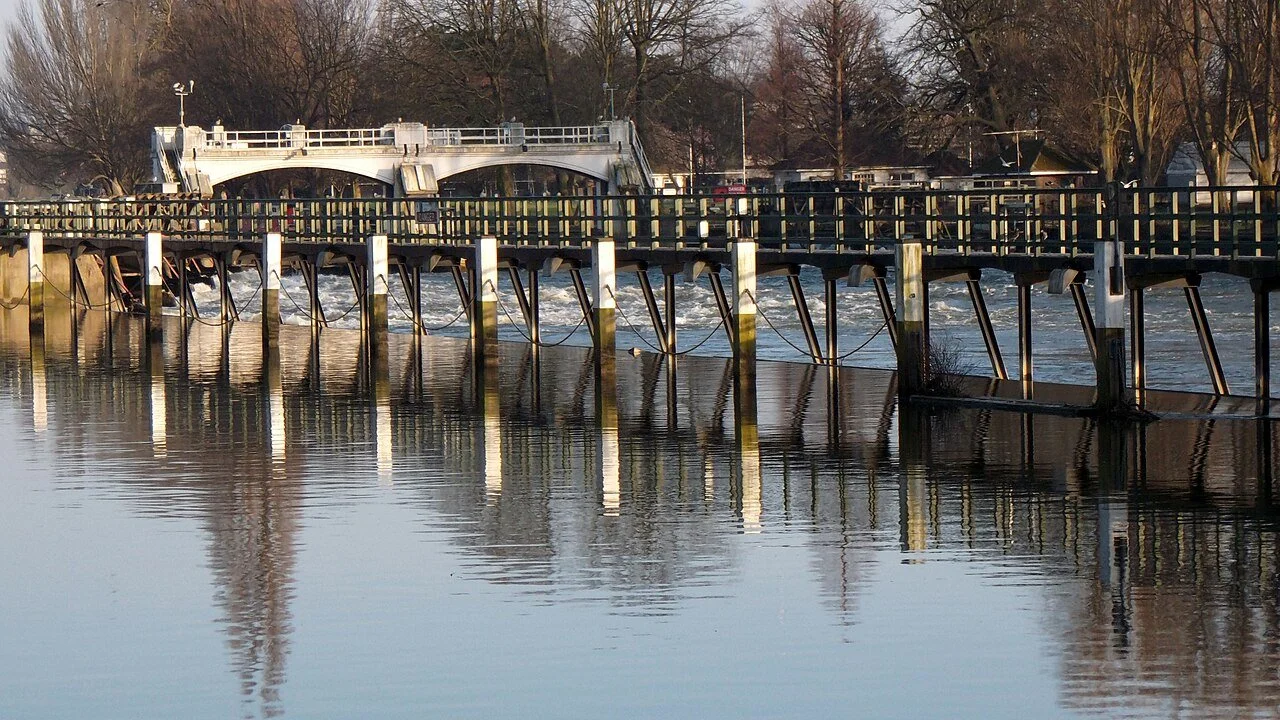
The principle is simple, even if the engineering is not. During drought, Thames Water would take up to 75 million litres a day from the River Thames just upstream of Teddington Weir. It would send that water through a new connection into the existing Thames Lee Tunnel, the 1950s raw water main that already carries Thames water from Hampton across London to the Lee Valley reservoirs. To protect the river below the weir, the same volume would be replaced with highly treated recycled water from Mogden Sewage Treatment Works, piped through a new tunnel to an outfall near the weir.
The scheme is designed to operate only when river and reservoir levels fall below set thresholds. The government has designated it a Project of National Significance, so it needs a Development Consent Order.
The main elements are:
a new tertiary treatment plant at Mogden Sewage Treatment Works;
a tunnel of up to 3.5m internal diameter, mostly 20m to 40m deep in London Clay, from Mogden to the river;
a new in-river outfall structure close to Teddington Weir; and
a new intake and connection to the Thames Lee Tunnel.
Thames Water's November project update, published to local residents, confirms that ground investigation and design work have allowed it to narrow the tunnel corridor considerably compared with the version published in 2025, so fewer properties now sit above it. The company has written to everyone it believes holds an interest in the subsoil beneath the route, which it would only acquire if the project is consented.
The design has been shaped by successive rounds of consultation since 2023. A change of tunnelling method in 2024 removed five intermediate shafts, and a sixth, at Ham Playing Fields, was dropped this year. All excavated material will now come out through a single worksite at Mogden. The latest changes move the new treatment structures, the tunnel drive shaft and the interception shaft to the southern edge of the Mogden site, to reduce the risk of disrupting the works while they stay in operation. The trade-off, Thames Water acknowledges, is more excavation and more construction lorries than previously estimated.
The company still intends to submit its DCO application to the Planning Inspectorate in spring 2027. It is holding a public webinar on tunnelling on 18 November.
The update opens with a stark picture of London's water position. Despite recent storms, London and the South East remain in drought, with London's reservoirs at 55% and October rainfall running at just over a quarter of the long-term average. The hosepipe ban remains in place, and Thames Water does not expect to lift it for some time. Its concern is not just this year, but whether resources recover before next spring.
That is the case for TDRA in a sentence. It is not a reservoir, and it will not solve London's long-term supply gap on its own. It is a drought scheme: capacity that sits ready for exactly the conditions London is living through now.
Why it matters for Confluence
TDRA is a useful window on the Major Water Infrastructure Programme for three reasons.
It shows the programme is about more than reservoirs. Alongside White Horse and Fens, the pipeline includes transfers, water recycling and schemes like TDRA that make better use of existing assets. They draw on very different skills: tunnelling, advanced treatment, river engineering.
It shows the consenting challenge. Three years of consultation, multiple design iterations and a DCO application still to come illustrate how much of the programme's risk sits before a spade goes in the ground. Building in one of the most densely occupied parts of London, beneath homes and next to an operational sewage works, makes public trust part of the engineering.
It shows the capability London already has. The update deliberately sets TDRA alongside Tideway, the Elizabeth line and the Northern Line Extension. London's tunnelling expertise is one of the UK's real strengths. The question for the programme is whether that capability can be sustained and shared across projects, rather than rebuilt from scratch each time.
Those are exactly the questions Confluence exists to explore: how the UK's water resilience projects become a programme the market can plan for, and that society can trust. Join the conversation at Manchester Central on 3 March 2027.
The drought has made the case. Now the consents have to follow.